How UK income tax, PAYE, tax codes and National Insurance work in 2026/27, plus what changes if you also have income or accounts in India. Stage tag: stage-settling
Tax rules change every year, so check gov.uk before acting on anything here. This is general information, not tax advice.
Your first UK payslip usually brings the same surprise: the number you were promised and the number that lands in your account are quite different. The gap is income tax and National Insurance, and in the UK both are taken out before you're paid.
That's very different from handling tax yourself after the year ends, and it surprises many people who are used to the Indian system. This guide explains how the UK system works, what the 2026/27 numbers are, and the extra questions that come up when you also have money in India.
The tax year runs from 6 April to 5 April
India's financial year runs from 1 April to 31 March. The UK tax year runs from 6 April to 5 April. The 2026/27 tax year began on 6 April 2026 and ends on 5 April 2027.
Two practical effects follow. Allowances and thresholds reset every 6 April, and the end of the tax year on 5 April is a sensible time to review your pension, savings and any tax paperwork.
How much tax you pay (England, Wales and Northern Ireland)
For 2026/27 the rates and bands for England, Wales and Northern Ireland are:
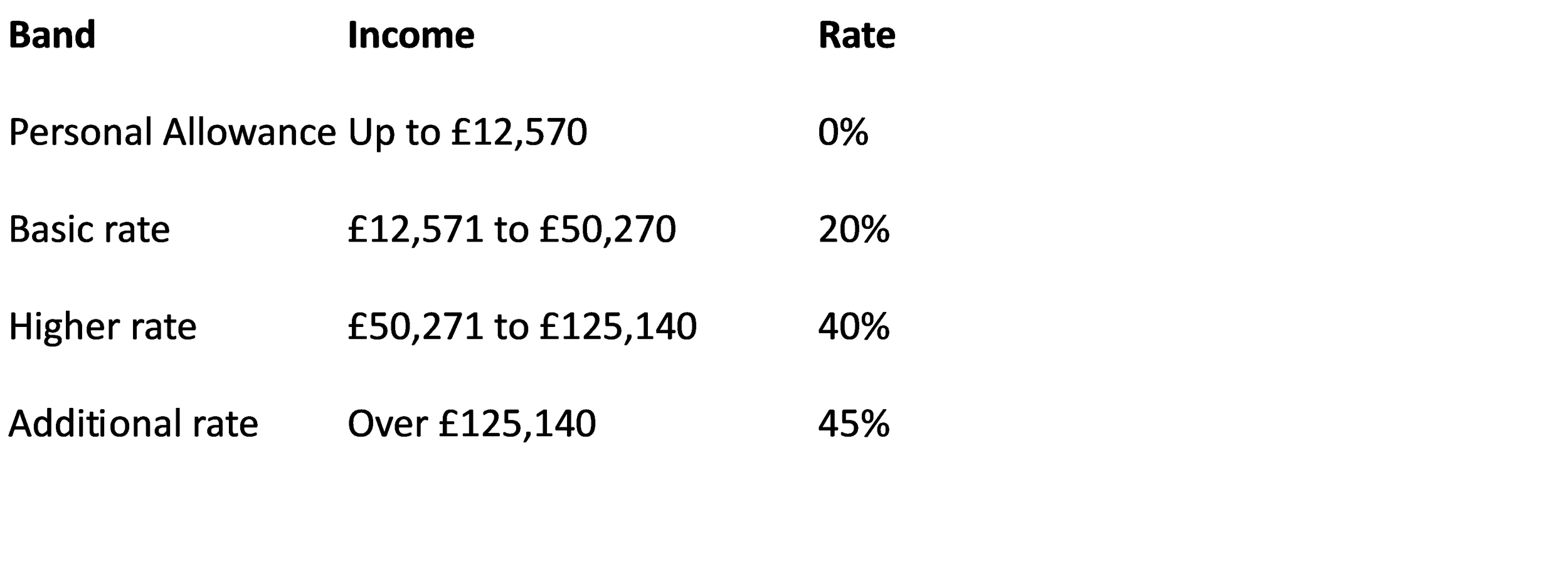
Tax is charged by band, not on your whole salary. If you earn £55,000, you don't pay 40% on all of it. You pay nothing on the first £12,570, 20% on the next slice up to £50,270, and 40% only on the part above that.
Two details worth knowing:
The £100,000 trap. Your Personal Allowance shrinks by £1 for every £2 you earn above £100,000, and it's gone completely at £125,140. In that stretch, the effective rate on each extra pound is around 60%.
Scotland is different. Scottish income tax has its own set of bands and rates, set by the Scottish Parliament. If you live in Scotland, check the Scottish rates on gov.uk.
These thresholds have been frozen for several years. The freeze is now expected to run to April 2031, but confirm the current position on gov.uk, because older articles still quote earlier end dates.
National Insurance: the second deduction
National Insurance (NI) is separate from income tax. For most employees in 2026/27 it works like this:
Nothing on earnings up to £12,570 a year
8% on earnings between £12,570 and £50,270
2% on earnings above £50,270
NI builds up your record for the State Pension and some benefits. You'll need a National Insurance number to work in the UK. If you don't have one yet, you can apply through gov.uk.
A worked example: £45,000 salary
Here's how it comes out for someone on £45,000 in England:
Income tax: (£45,000 minus £12,570) x 20% = £6,486
National Insurance: (£45,000 minus £12,570) x 8% = £2,594
Take-home before anything else: about £35,920 a year, or roughly £2,993 a month
That's before pension contributions, student loan repayments or any other deductions on your payslip. Our take-home pay calculator, which converts the result into rupees, is coming soon.
How PAYE works
PAYE stands for Pay As You Earn. Your employer works out your income tax and National Insurance each payday, takes them from your pay, and sends them to HMRC. For most people on a single salary, that's the end of it. There's no separate bill and no tax return.
Your tax code
Every payslip shows a tax code, which tells your employer how much tax-free pay to give you. The standard code for 2026/27 is 1257L. The number reflects the £12,570 Personal Allowance, and the letter L means you get the standard allowance.
Check it on every payslip. A wrong code is one of the most common and easily fixed reasons people overpay.
Emergency tax codes
If you've just started a job, your first payslips may show an emergency code, often ending in W1, M1 or X. It means your employer didn't yet have the details HMRC would normally send, so you may be taxed more heavily than you should be for a while. Your employer and HMRC can fix it, and any overpayment is normally corrected. Check your code early rather than waiting.
When you might need a tax return
Most employees on a single salary don't file a tax return. You may need to use Self Assessment if you:
Have self-employed or side income above the £1,000 trading allowance
Receive rental income
Earn £100,000 or more
Have income from abroad, including interest or rent from India
Check gov.uk to confirm whether the rules apply to you. If you start a side business, you can register with HMRC when your income from it passes £1,000 in a tax year.
The UK-India angle: what changes with money in India
This is where most generic UK tax guides stop, and where readers with accounts in India have the most questions. The points below are a general outline, and your own position depends on your residence status, how long you've been in the UK and what income you have.
UK residence is its own test
Whether you're a UK tax resident is decided by the Statutory Residence Test, which looks at days spent in the UK and your ties here. It isn't decided by citizenship or visa type, and it's separate from India's rules. You can be treated as resident in both countries in the same year. See our [NRE vs NRO vs FCNR guide] for how India decides residence for accounts.
UK residents are taxed on worldwide income
Since 6 April 2025, UK residents are generally taxed on their worldwide income and gains as they arise. That includes interest from Indian accounts, rent from Indian property and dividends from Indian shares, even if the money never comes to the UK.
A four-year relief for qualifying new arrivals
A relief called the Foreign Income and Gains (FIG) regime can exempt foreign income and gains from UK tax for up to your first four years as a UK resident. It's aimed at people who have been non-UK resident for the ten tax years before arrival. It has to be claimed through Self Assessment, and it ends after four years. If it applies to you, it can matter for interest on accounts such as NRE and FCNR. If it doesn't, that interest can be taxable in the UK even though India doesn't tax it.
The earlier "remittance basis," where only money brought to the UK was taxed, ended in April 2025, so older articles describing it are out of date.
Tax paid in India
Interest on an NRO account, for example, usually has tax deducted in India. The UK-India double taxation agreement exists so the same income isn't fully taxed twice, but relief generally has to be claimed. We will cover this in our upcoming [UK-India DTAA guide].
What to do
Keep records of income and tax paid in both countries, note when you arrived, and speak to a qualified cross-border tax adviser before making large decisions. This is the area where one hour of professional advice is most likely to be worth the fee.
Quick checklist
[ ] Look at the tax code on your latest payslip
[ ] Check for an emergency code if you've just started a job
[ ] Note your arrival date and whether you've had ten years outside the UK
[ ] Keep records of any Indian interest, rent or dividends
[ ] Set a reminder for 5 April to review your tax position
[ ] Find out whether you need to file a Self Assessment return
Common questions
Do I pay tax in both India and the UK on the same income? Possibly. The treaty is designed to reduce double taxation, but relief usually has to be claimed. See our DTAA guide and speak to an adviser.
Is NRE interest taxable in the UK? It can be. NRE interest is tax-free in India, but UK residents are generally taxed on worldwide income. New arrivals who qualify for the four-year FIG relief may be exempt for a time if they claim it.
Do I need to file a tax return? Most employees on a single salary don't. Side income, rental income, foreign income or high earnings can change that. Check gov.uk.
What is the UK tax year? 6 April to 5 April.
What's next
To understand the numbers on your payslip line by line, read our upcoming [How to Read Your UK Payslip]. And if you haven't yet, grab our free [UK-India Money Starter Checklist].
This article is general information based on published UK rates for 2026/27. It is not financial, tax or legal advice. Rules and thresholds change, and your correct position depends on your circumstances. Check gov.uk and speak to a qualified adviser before making decisions.