Now that your UK account is up and running (see our Best UK Bank Accounts for New NRIs guide if you haven't set one up yet), the next question almost everyone in this position asks is the same: what's the cheapest way to actually get money to India?
Most people compare transfer fees and stop there. That's the mistake. The fee is often the smaller cost. The bigger one — the one banks are far less upfront about — is hidden in the exchange rate itself.
The Hidden Cost Nobody Points Out
Every currency has a "mid-market rate" — the real, real-time rate you see when you Google "GBP to INR" or check a site like XE. This is the rate banks and institutions trade at with each other. It is not the rate most providers give you.
Traditional banks typically apply a margin on top of this rate — sometimes 2-4% worse than the mid-market rate — while advertising "no transfer fee" or "free international transfers." The margin is baked into the rate itself, so it's invisible unless you specifically compare it to the mid-market figure. A provider charging zero fee but a noticeably worse rate can end up costing you more overall than one that charges a small visible fee but gives you the real rate.
The rule that actually matters: always compare the total INR your recipient receives — not the advertised fee, and not the headline rate alone.
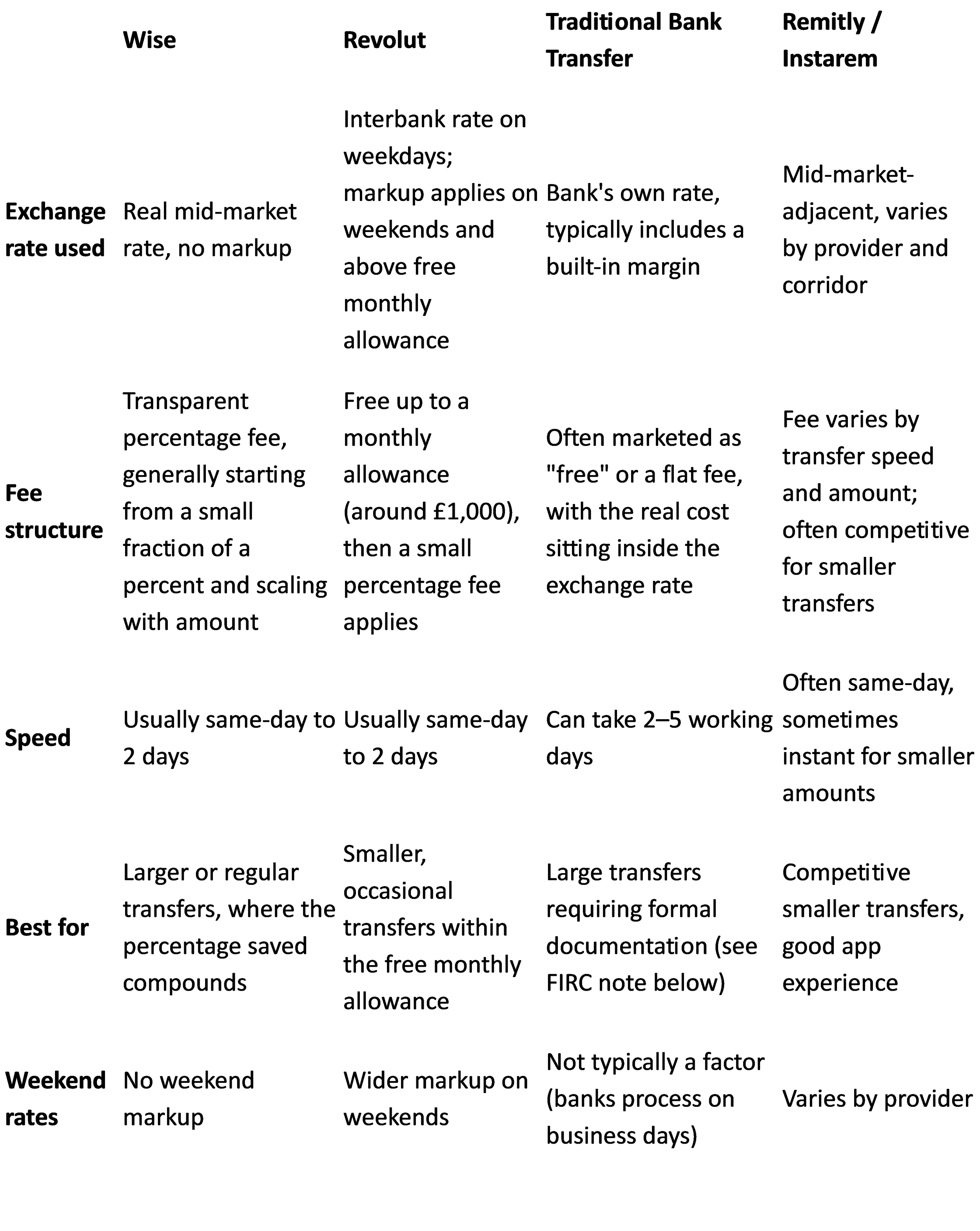
Head-to-Head Comparison
Check our comparison tool
Exact fees, allowances, and rates change frequently and vary by transfer size — always check the live calculator on each provider's site with your specific amount before sending.
A Real Example: Sending £1,000 to India
To make this concrete, here's how the comparison actually plays out in practice:
Wise: applies the real mid-market rate with a small transparent percentage fee — on a transfer of this size, the fee typically works out to a modest, clearly displayed amount, with no hidden markup in the rate itself.
Revolut: if you're within your monthly free FX allowance, a transfer this size can cost very little in fees — but if you're outside the allowance or sending on a weekend, the effective cost rises due to the rate markup.
Traditional bank transfer: often advertised with no visible fee, but the built-in exchange rate margin means your recipient can end up with noticeably fewer rupees than the mid-market rate would produce — sometimes the largest hidden cost of the four options.
Remitly/Instarem: competitive on smaller amounts like this, worth comparing directly at the time of transfer since promotional rates for first-time or smaller transfers are common.
The practical takeaway: for a transfer of this size, Wise or a promotional-rate app like Remitly/Instarem usually beats a traditional bank transfer once you account for the real exchange rate — but always run your exact amount through each provider's live calculator, since rates move daily and promotions change.
A Note for Larger Transfers (Above ~£10,000)
If you're sending a larger sum — for a property purchase, investment, or major family expense — there's an important documentation point beyond just cost: for transfers of this size, it's worth using a route that can generate a FIRC (Foreign Inward Remittance Certificate) from the receiving Indian bank. This certificate matters for tax documentation, property purchase records, and any future capital gains treatment. Not all fintech providers automatically generate this, so it's worth confirming before choosing a provider for a large, formal transfer — a traditional bank wire or a provider explicitly supporting FIRC/eFIRC may be the safer choice here even if a fintech app is marginally cheaper.
Which Should You Actually Use
If you send money occasionally and in smaller amounts: Revolut's free monthly allowance makes it genuinely cost-effective, provided you stay within the limit and avoid weekend transfers.
If you send money regularly or in larger amounts: Wise's transparent, no-markup structure tends to win as amounts grow — the percentage saved on the exchange rate compounds meaningfully at scale.
If you're making a large, formal transfer (property, investment, tax-relevant amounts): prioritise documentation (FIRC/eFIRC support) alongside cost — a slightly higher fee is worth it if it saves you a paperwork headache later.
Sensible approach for most people: hold accounts with both Wise and Revolut, and check both calculators against your specific amount before each transfer — since the cheaper option can shift depending on transfer size and timing.
What's Next
Once you're comfortable moving money between the UK and India, the next natural question is what to actually do with money sitting in India — specifically, understanding NRE, NRO, and FCNR accounts, which most explainers get wrong for someone actually living abroad rather than just visiting. That's exactly what we cover next: NRE vs NRO vs FCNR Accounts Explained for Someone Living in the UK.
Disclosure: This post may contain referral links. If you sign up through one, we may receive a small commission at no extra cost to you. We only recommend products based on genuine research — see our full Affiliate Disclosure for details.