If you read our Best UK Bank Accounts for New NRIs guide, you've already got an account open. This post is different: it's not about which app will accept you as a newcomer — it's about which one is actually worth keeping as your main account once you're settled, and how they stack up specifically for someone managing money across the UK and India.
Revolut, Monzo, and Starling are the three names that come up constantly, and the honest answer is that none of them is a universal winner — a genuinely common pattern among people in your position is running more than one, each for a different purpose. Here's what actually differs.
Quick Verdict Table
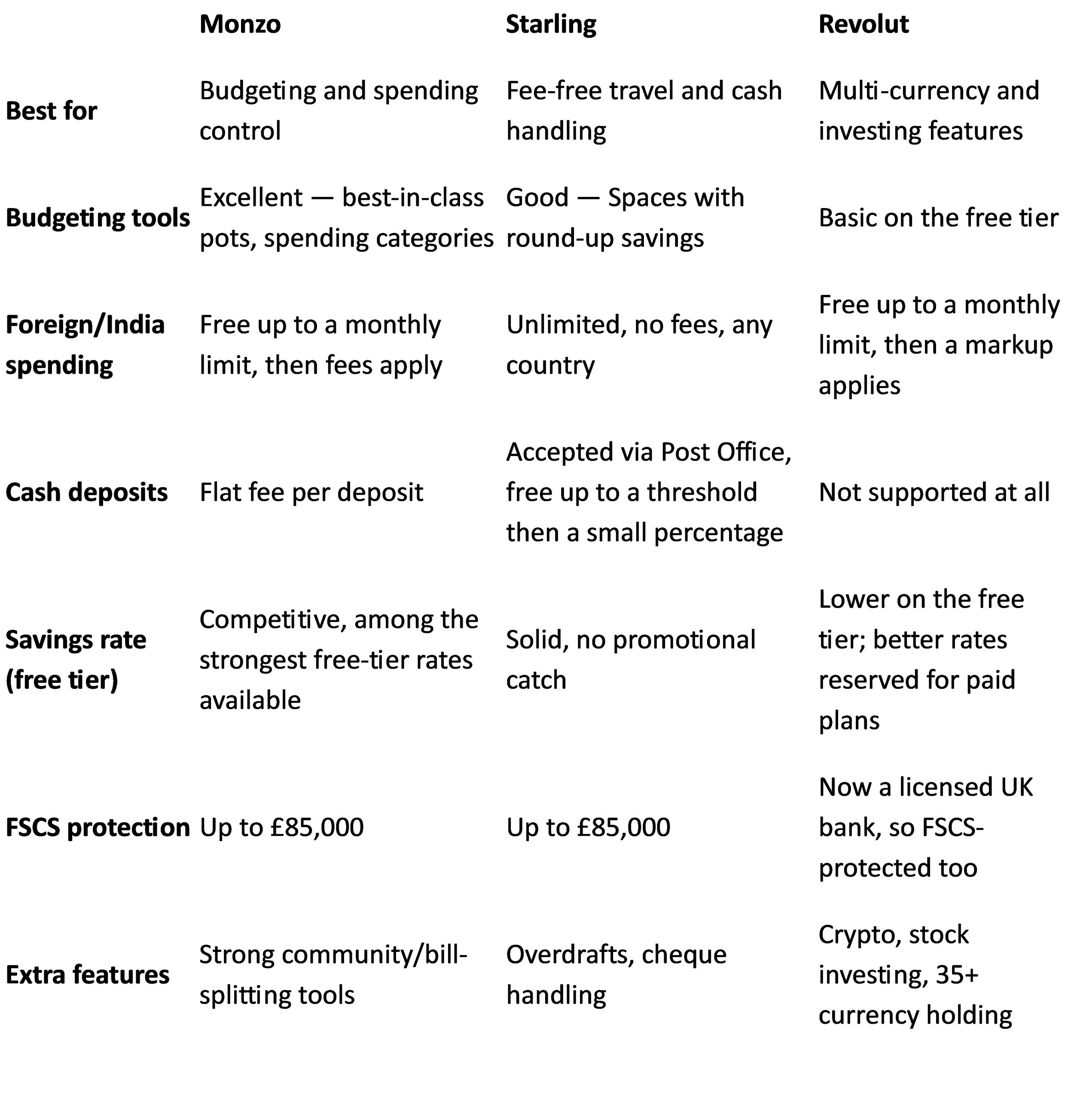
Full Comparison
Amongst best UK digital banks
Specific rates, limits, and fees shift regularly — always check each provider's current terms directly before relying on a number here.
Where Each One Actually Wins
Monzo: Best for Everyday Budgeting
If your main challenge is staying on top of spending — especially useful in your first year juggling UK bills alongside remittances home — Monzo's categorisation and spending pots are widely regarded as the strongest in this category. It automatically sorts spending, lets you set savings pots for specific goals, and makes bill-splitting with flatmates or family straightforward.
Where it falls short for your situation: foreign spending is only fee-free up to a monthly cap, so if you're making frequent India-related payments beyond everyday remittances (which usually go through Wise or Revolut anyway, per our [money transfer guide]), this limit may matter less than it would for someone using Monzo as their primary travel card.
Starling: Best for Fee-Free Foreign Spending and Cash
Starling's standout feature is straightforward: no fees abroad, no monthly cap, in any country — including when you're visiting family in India and paying for things locally on your card. It also handles cash deposits more generously than Monzo, which matters if you ever receive cash gifts or payments.
Where it falls short: its budgeting tools, while solid, are generally considered a step behind Monzo's — fine if budgeting isn't your main priority, more noticeable if it is.
Revolut: Best for Multi-Currency Holding and Extra Features
If you're holding money in more than just GBP — useful if you're paid partly in another currency, or want to hold INR-adjacent currency exposure without constantly converting — Revolut's ability to hold 35+ currencies in one account is unmatched by the other two. It also bundles in investing and crypto features if that's relevant to you, and recently became a fully licensed UK bank, meaning standard UK deposits now carry the same FSCS protection as the other two.
Where it falls short: its free-tier budgeting tools are the most basic of the three, and foreign spending above the free monthly allowance picks up a markup — worth checking against Starling's unlimited free foreign spending if that's your main use case.
A Practical Combination Worth Considering
A pattern that comes up often, and genuinely fits a UK-India life well: Starling for everyday spending and any India-related card use (fee-free, no cap), Monzo for budgeting and bill management, and Revolut held separately for multi-currency flexibility or if you want investing features in the same app. Running all three isn't necessary, but running two — Starling plus Monzo, most commonly — covers nearly every gap either one has alone.
Which One Should You Actually Pick, by Priority
Budgeting and spending control matter most to you → Monzo
You travel to India often, or spend on your card while there → Starling
You want multi-currency holding, investing features, or a single app that does everything → Revolut
You're not sure yet → Start with Starling as your main account (no foreign fees, solid all-round feature set) and add Monzo later specifically for budgeting once you have a clearer sense of your spending patterns.
What's Next
If you haven't already set up the cheapest way to actually move money between these accounts and India, our money transfer comparison covers exactly that. And if you're still building your UK credit profile, our credit-building guide walks through the steps that work alongside whichever of these you choose as your main account.
Disclosure: This post may contain referral or affiliate links. If you sign up through one, we may receive a small commission at no extra cost to you. See our full Affiliate Disclosure for details.