Gross pay, tax code, National Insurance, pension and net pay explained line by line, with a worked example and five checks to make on every UK payslip. Stage tag: stage-settling
Last reviewed: [24-11-2026]. Tax and pension rules change every year, so check gov.uk. This is general information, not tax advice, and this post contains no affiliate links.
Your first UK payslip arrives, and the number at the bottom is lower than the salary in your offer letter. Before you wonder where the money went, it helps to know how the document is laid out.
A UK payslip looks different from an Indian salary slip. In India, pay is often discussed as CTC, which can include employer contributions and benefits. In the UK, salary offers are normally quoted as gross annual pay, and the employer's pension contribution and employer National Insurance sit on top of that figure, not inside it.
This guide walks through a payslip line by line, with a worked example, and ends with five checks worth making every month.
Your payslip is a legal document
Under the Employment Rights Act 1996, your employer must give you an itemised payslip on or before payday. It must show your gross pay, each deduction with the amount and reason, and your net pay. Since April 2019 the right covers all workers, not just employees, and if your pay varies with hours, the hours must be shown. Payslips can be on paper or online.
Keep every one. Landlords, lenders and visa applications often ask to see recent payslips.
The top of the payslip
The top section tells payroll how to treat you.
Pay period and date: the month or week the payslip covers, and the payday.
Tax code: most employees have 1257L in 2026/27. The number reflects the £12,570 Personal Allowance and the letter L means the standard allowance.
National Insurance number: the number you applied for when you started working in the UK.
NI category letter: a single letter that sets which National Insurance rates apply. A is the standard letter for most employees aged 21 up to State Pension age. Others include M for under 21s, H for apprentices under 25 and C for people over State Pension age.
If your tax code looks different
W1, M1 or X after the number: an emergency code. It usually means your employer didn't yet have your details from HMRC, and you may be taxed more heavily for a while until it's corrected.
BR: all your pay is taxed at the basic rate, with no allowance. It's common on a second job.
0T: no tax-free allowance at all.
If the code isn't what you expect, tell payroll and check with HMRC. Our guide to UK Tax Explained for Indians covers how the tax code and Personal Allowance fit together.
The middle: what you earned
Gross pay: everything you earned in the period before any deductions. For a monthly salary, it's your annual salary divided by 12.
Additions: overtime, bonuses, allowances, or statutory payments such as sick pay. These appear as extra earnings, not deductions.
The deductions
Most payslips show some or all of these.
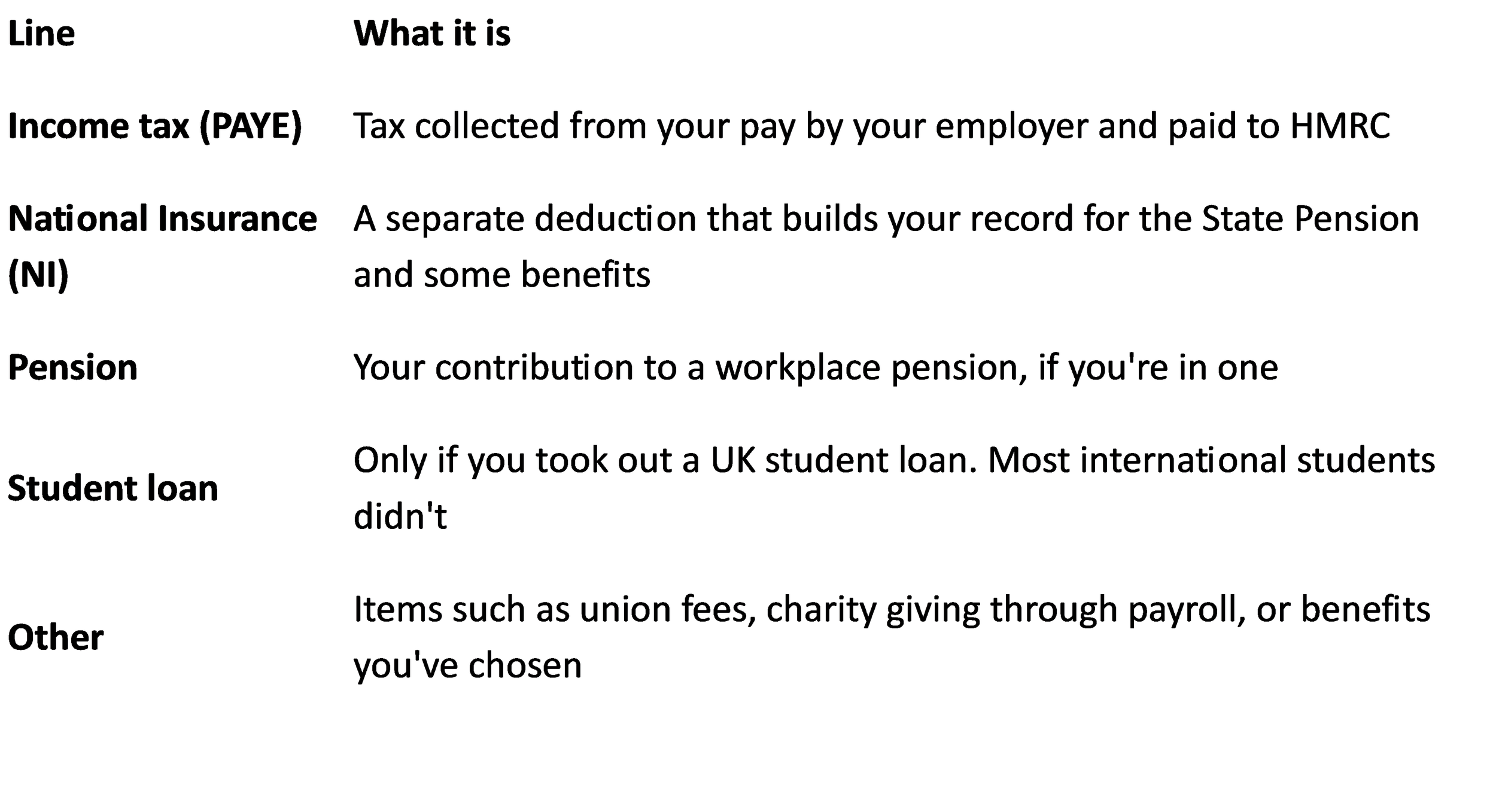
Some employers use salary sacrifice for pension or other benefits. Your gross pay is reduced before tax and National Insurance are worked out, so check with HR how it affects your payslip.
How the workplace pension line works
If you're 22 or over, work in the UK and earn above £10,000 a year, your employer must normally enrol you in a workplace pension. For 2026/27 the minimum total contribution is 8% of qualifying earnings, which means pay between £6,240 and £50,270 a year. At least 3% must come from your employer, and the rest from you, including tax relief. Some employers pay more than the minimum, so check your contract.
Our [workplace pension guide] explains this in more depth.
The bottom: net pay and year-to-date
Net pay: the amount paid into your bank. Check it matches what actually arrived.
Year-to-date (YTD) figures: running totals for the tax year, which started on 6 April. They usually show gross pay, tax and National Insurance so far. They help you and HMRC see that the right amounts are being collected.
At the end of the tax year you should receive a P60, a summary of your pay and tax for the year. If you leave a job you'll get a P45, which your next employer will ask for.
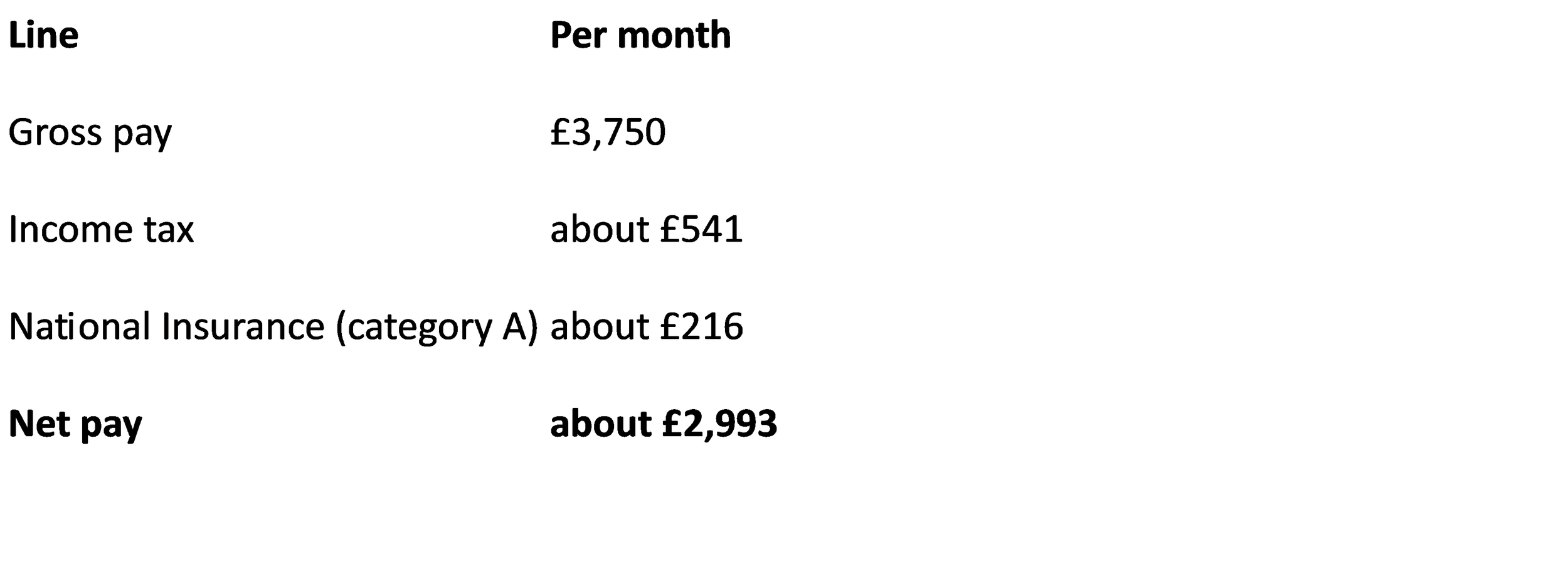
A worked example: £45,000 salary
For someone on £45,000 a year in England, with no pension or student loan:
Check our UK Salary Calculator Tool to check various scenarios.
Your real payslip may differ by a few pounds because of rounding, your tax code and how payroll spreads allowances through the year. A pension contribution would reduce your take-home further, though tax relief means it falls by less than the amount you pay in.
Five checks to make every month
Tax code: is it what you expect, and not an emergency code that's lasted months?
NI letter: is it right for your age and circumstances? The wrong letter means the wrong rate.
Pension: is the amount what your contract says, and is your employer paying in too?
Pay and hours: do the gross pay and any additions match what you agreed?
Net pay: does it match the money in your bank account?
If something looks wrong
Ask payroll or HR first. Most errors are simple and are fixed in the next pay run.
Contact HMRC if it's about your tax code or tax deducted.
Keep a note of what you asked, when, and the answer.
The UK-India angle
Your net pay is the real starting point for planning how much you can send home, because it's what you actually have after deductions, not the headline salary. Once you know your monthly figure, our UK India money transfer cost calculator shows what each provider would give your family in India.
If you also have income in India, the payslip only covers your UK pay. Rules on reporting Indian income to HMRC are covered in UK Tax Explained for Indians.
What's next
Our free UK-India Money Starter Checklist is a good companion for your first year. Our set by step guide gives you a good view of how to build your finances in UK.
This article is general information based on published UK rates and rules for 2026/27. It is not financial, tax or legal advice. Your payslip may differ depending on your employer, pay frequency and circumstances. Check gov.uk and speak to a qualified adviser before making decisions.