Landed in the UK with no credit history? Here's which UK bank accounts actually accept newcomers, compared on fees, requirements, and app quality.
You've just landed in the UK — new visa, new address, new job or course starting soon — and the first thing on your list is opening a bank account. Then you hit the wall almost everyone in this position hits: most UK banks assess new applicants using credit reference agencies, and if you have no UK credit file (which is true for essentially every new arrival), the bank has nothing to check you against. The result is often a straight rejection, or approval for a stripped-down basic account with no overdraft and limited features.
It's not personal, and it's not really about your financial standing back home — a UK bank simply can't "see" a credit history that was built in India, the US, or anywhere else. The good news: a specific set of banks and apps have built their onboarding around this exact problem, and a growing number of newcomers now open one of these before ever walking into a traditional branch.
The Quick Answer
If you want to stop scrolling and just get moving, these are the four worth actually considering:
Monzo — best all-round everyday account for newcomers, no UK credit history required
Starling — strong choice if international transfers matter to you from day one
Revolut — best if you want multi-currency holding alongside a UK account
Wise — not a full bank account, but the strongest option if your main need is holding and moving money in multiple currencies rather than day-to-day spending
All four can be opened remotely, verify your identity rather than your credit history, and typically take under fifteen minutes to set up.
Why Digital Banks Work Where High Street Banks Don't
Traditional banks like Barclays, HSBC, and Lloyds still serve newcomers, but often with extra friction: Barclays requires a Biometric Residence Permit or equivalent to open an account online, HSBC generally asks for proof of address that new arrivals frequently don't have yet, and most high-street banks are built around an assumption of prior UK residency that simply doesn't apply to you yet.
Digital-first banks took a different approach from the start — verifying identity through passport/BRP scans and facial verification rather than requiring a credit check or long address history. That's the structural reason they've become the default recommendation for new arrivals, regardless of nationality or visa type.
Comparison Table
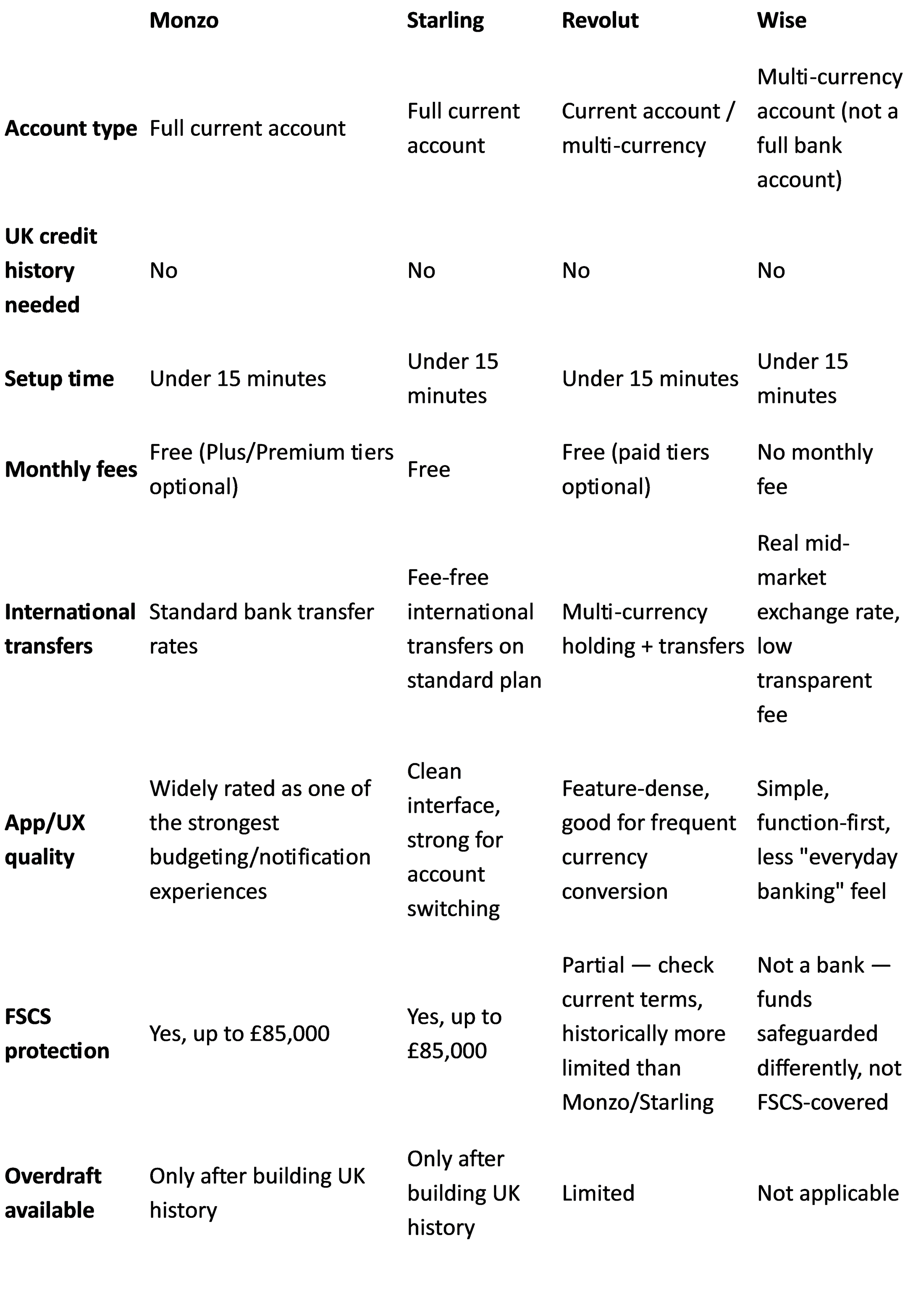
Fees, limits, and protection terms change — always confirm current details directly on each provider's website before opening an account.
Which One Should You Actually Pick
If you're on a student visa: Start with Monzo or Starling as your everyday account for rent, groceries, and bills. Neither requires a UK credit file, and both give you a functioning account within your first week. Add Wise separately if you're regularly receiving money from family back home — the fee savings on larger transfers add up quickly over a degree's length.
If you're on a Skilled Worker visa: Starling's fee-free international transfers are worth prioritising if you're likely sending money home regularly from your first UK salary. Pair it with Monzo if you want stronger day-to-day budgeting tools — many people run both, using one for salary/bills and the other for spending tracking.
If you're relocating with family: Revolut's multi-currency holding is genuinely useful if your household is managing expenses in both GBP and INR simultaneously — school fees, remittances, and property-related payments back home often involve currency you don't want to convert immediately. A joint high-street account (Santander's Basic Current Account is a reasonable low-barrier option) alongside a digital account for flexibility is a common combination for families.
In every case: open your digital account first, use it for 3–6 months to start building a UK financial footprint, then apply to a high-street bank if you specifically need a mortgage, larger overdraft, or in-branch services later. Trying to start with a traditional bank as a brand-new arrival is usually the slower, more frustrating path.
A Note on Referral Bonuses
Several of these providers run refer-a-friend programmes that pay both sides a small bonus for signing up through a referral link. The amounts and terms change frequently and are sometimes not published at all — treat any specific figure you see quoted online (including here) as unverified until you check the current offer directly in the provider's app or official page before signing up.
What's Next
Once your account is open, the next question is almost always the same one: what's the cheapest way to actually send money to India from it? Bank transfers, Wise, and Revolut all handle this very differently — and the difference in cost on a single transfer can be larger than people expect. That's exactly what we're covering next: How to Send Money from the UK to India Cheaply — Wise vs Revolut vs Bank Transfer.
Disclosure: This post may contain referral links. If you sign up through one, we may receive a small commission at no extra cost to you. We only recommend products based on genuine research — see our full Affiliate Disclosure for details.